Califa Cards + Skill Foundry
Self-initiated. A portable standard for Claude Agent Skills, written alongside the security-scanned library that exercises it.
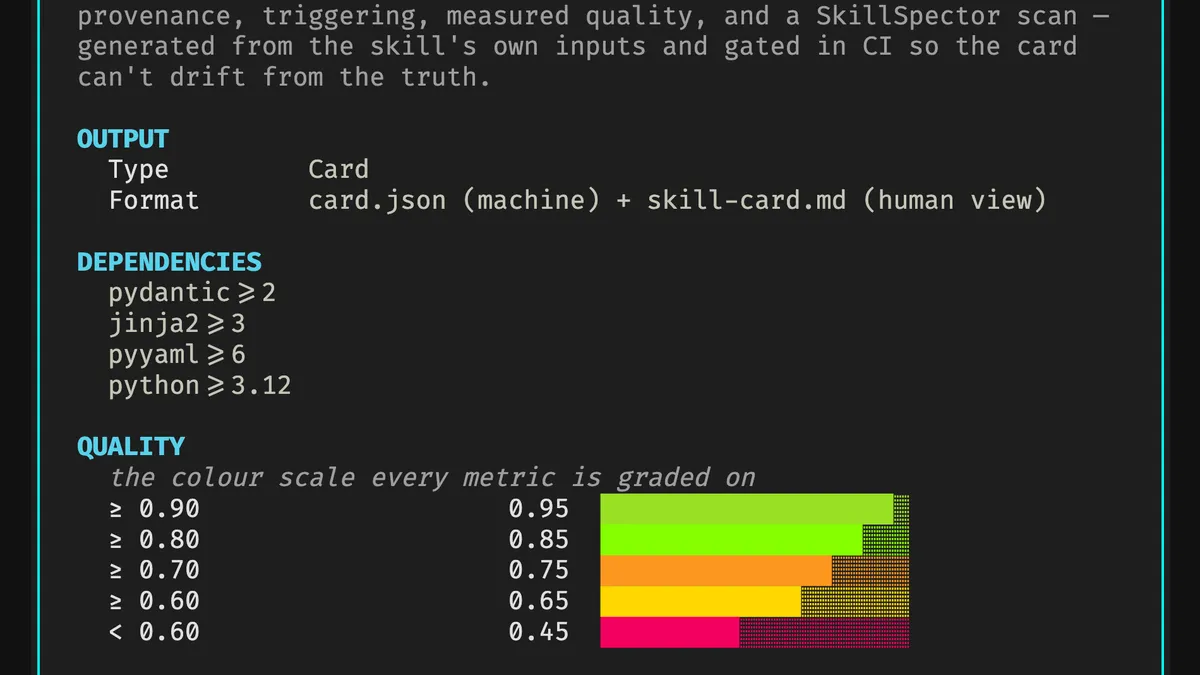
The applied library: six security-scanned Claude Agent Skills, four of them carded. Every carded skill carries a Skill Card, a SkillSpector scan plus trigger evals, generated and gated in CI so the catalog cannot drift from what was measured.
The spec and the skillcard CLI. A pydantic schema is the single source of truth where prose and code might disagree; the CLI validates, builds, gates, hashes, reviews, evals, and optimizes a card. The foundry's first published trigger evals ran on this harness: precision and recall 1.00 for two skills, measured live against claude-opus-4-8, with unmeasured skills shown as a dash.
Context
Claude Agent Skills are easy to write and hard to trust at scale. A skill folder claims what it does, what it triggers on, and that it is safe to run, and nothing forces those claims to match the bytes on disk. Pull a dozen skills into a catalog and the descriptions drift from the code, the security posture is a shrug, and there is no shared way to say how reliably a skill fires when it should.
Califa Cards is the standard that closes that gap, and Skill Foundry is the library that proves the standard holds under its own weight.
Approach
The Skill Card is a portable, versioned record of one skill: its identity, provenance, capability, behavior, quality metrics, and security posture. Two repos carry the work.
califa-cards is the spec and the skillcard CLI. A pydantic schema is the single source of truth, so the prose and the code cannot disagree. The CLI builds a card from a skill folder, runs the security gate, and hashes the source. The card is keyed to a content_hash of the skill folder, so a card always describes the exact bytes it was built from. An NVIDIA SkillSpector scan lands in the card as a 0 to 100 risk score, banded so a LOW result passes and a HIGH or CRITICAL result fails the build. A trigger and task-completion eval harness measures how reliably a skill fires on the inputs it should and stays quiet on the inputs it should not.
claude-skill-foundry is the applied library: six security-scanned skills, four of them carded at the time of writing. The cards are generated and gated in CI, on every push, so the published catalog cannot drift from what was last measured.
Honesty about the edges
Trigger precision and recall are live measurements, and as of July 2026 two of the four carded skills publish them: bubbletea and ratatui both measure precision and recall of 1.00 across 24 queries at three runs each, with a functional pass rate of 0.976. The other carded skills still show a dash because their eval sets are not authored yet, and the catalog does not print a number it cannot back up.
A discovery layer, the Discover Worker, would let an agent find the right skill by capability at the edge. It is specified as a design stub, not built. It is named here as a plan, not a feature.
Outcome
The transferable result is the discipline, not the catalog. A skill carries a card; the card is gated in CI against a security scan and a content hash; the eval harness keeps the trigger claims honest. The same structure fits any place a growing library of agent capabilities needs provenance and a measured floor on quality, rather than a README and a hope.